






News
Designed for industrial applications, the system provides 10 minutes of runtime at full load. Its architecture is based on easily replaceable standard 50 kW power modules and cabinets housing the lithium batteries, which take up much less space and tolerate higher temperatures better than standard batteries.
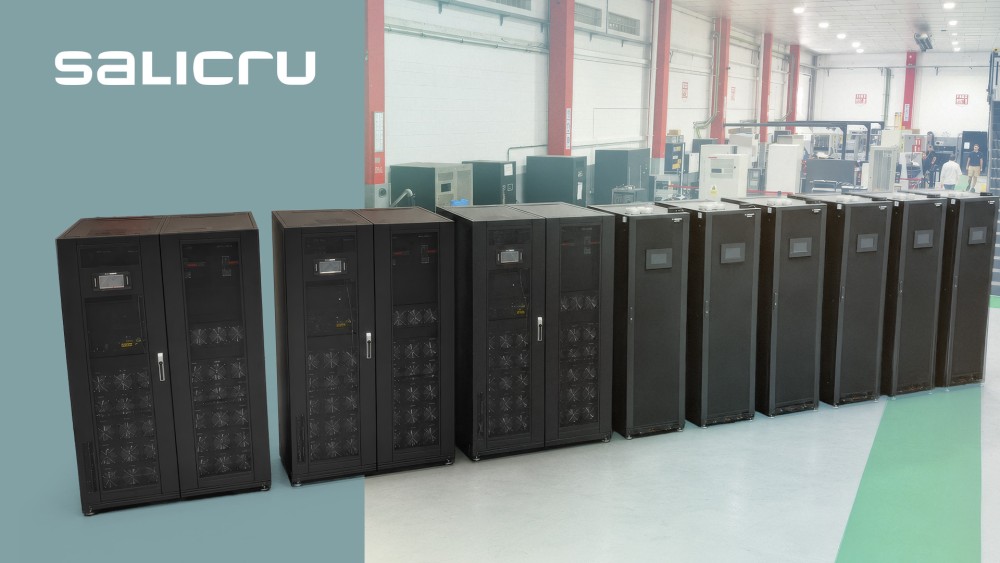
Salicru has manufactured a 1.5 MW uninterruptible power supply system (UPS) to protect the facility against power supply interruptions, particularly the micro-outages that are common at the factory’s location. The installation addresses the need to maintain continuity across the entire plant.
The solution includes standard 50 kW power modules. This limits the capacity affected by work on a module to 50 kW and simplifies replacement and maintenance. The hot-swap modules can be replaced while the equipment is operating.
Complete modularity to simplify maintenance
Parallel architectures are available on the market. These installations group several standalone units, connected to one another to form a high-power system. This arrangement simplifies physical integration, but each unit retains its own components, such as the charger, static bypass and control system.
This approach is suitable for many installations, but it is important to consider that, during maintenance or a fault, it reduces the energy capacity available in larger blocks. It may also take longer to coordinate the units’ response to sudden changes in load or frequency. Their size and weight, together with a less standardised design, can make replacement tasks and spare parts availability more challenging.
The SLC ADAPT2 offers modularity based on lower-capacity power modules, ranging from 10 to 50 kW depending on the configuration. If maintenance is required, work is focused on the affected module, which can be handled and replaced more easily while the system is live. Only the module needs to be replaced, which also helps simplify spare parts management.
Lithium batteries adapted to the installation
Space for the batteries was limited. To meet this requirement, Salicru proposed lithium batteries instead of traditional lead-calcium batteries designed for UPS applications. The selected configuration provides around 10 minutes of autonomy at 1.5 MW, more than twice the initial target. It also offers a much lower total cost of ownership, a considerably longer cycle life and greater tolerance to higher temperatures.
The solution also makes it possible to use sleep mode. With sufficient power available, the system can adjust module operation to the load while retaining reserve capacity, combining redundancy with operational efficiency.




 MONTAWEB.com