







All electrical supplies must be characterised by their reliability, continuity and quality. That said, in the case of installations of a critical nature such as transport, energy, hydraulic or telecommunications infrastructures, the demand level is higher still. Not surprisingly, work activities and the daily life of innumerable companies and people depend on the correct operation of these assets.
Roads, railways and airports, as well as the networks that transport electricity, water and fuel are notable examples of these types of infrastructures for which a lack of reliability and continuity is totally unacceptable. As regards quality, special care must be taken as regards electrical disturbances that may be detrimental to their proper performance. These disturbances may be a very different kinds and they may all affect not only the fitness of the supply but also its continuity.
In fact, from transient pulse overshoot, outages and micro-outages to fast transients, overvoltages, voltage dips, frequency fluctuations, transient oscillations and variations of the voltage can have a serious impact that requires adding various systems capable of overcoming and avoiding the effects of these variations. These systems are: UPSs (uninterruptible power supply) which store energy and offer a continuous AC supply; variable frequency drives that control the rotary speed of machinery and motors; DC/AC systems that ensure the stability of the output voltage; as well as transformers and auto transformers capable of adjusting the voltage level coming from the distribution network.
A leading company in the power electronics sector, such as Salicru, includes all those products in its catalogue capable of ensuring the optimal supply of critical infrastructures.
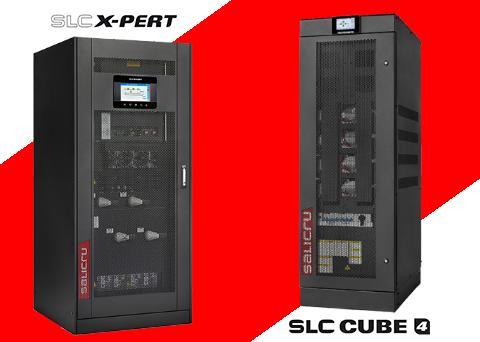
In the specific case of the UPS, the SLC CUBE4 and SLC X-PER within its wide range should be highlighted. Both are based on on-line double conversion technology, which currently offers the most advanced level of protection for critical systems as it provides a fully stabilised and filtered sine-wave supply voltage. All these UPSs provide an output power factor of 1.
In the case of the SLC CUBE4 series, these UPSs for powers of 7.5 to 80 kVA rely on a 4 core DSP controller and among its most notable features are an input current distortion rate (THDi) of less than 3% and in energy efficiency greater than 96% (in on-line mode) and up to 99% (in Eco-mode). In addition they have Nimbus IoT connection for monitoring and are compatible with all types of batteries (including lithium-ion), as well as power generators. They include USB, RS-232 and RS-485 interfaces and relays.
For its part, the SLC X-PER series is made up of UPSs for higher powers: between 80 and 400 kVA, therefore they are intended for critical high-power installations require high-performance protection. Their THDi is also below 3% and incorporate double input connection with the aim of increasing availability. There two operating modes reach an energy efficiency of 95% to 96% (normal mode) that increases up to 97% (High-Efficiency mode). All this enormously versatile systems which allow connection in parallel of two units of different powers.
The suitability of Salicru UPSs has been recognised by such important companies as Repsol, ADIF, Iberdrola, CAF, AENA, Siemens, Thales Rail, Pemex and EDP, to name but a few.


 MONTAWEB.com