






The performance of any electronic device can be represented as a curve that arcs over time to the end-of-life point (1). On a smaller scale, the same is true for consumable components (2) such as batteries, capacitors or, for example, in the case of UPS systems, fans. The distance between the starting point of the life of a device or component and the end-of-life point will depend largely on its operating conditions. Optimum conditions are achieved when the equipment has a sufficiently good power quality, loads appropriate to its topology and efficient and regularly performed maintenance. This requires optimal dimensioning and a good maintenance service, both of which SALICRU can provide with the utmost assurance of the desired outcome.
In the era of the Internet of Things, preventive measures have been taken to a new level with the possibility of obtaining, analysing and managing data in real time.
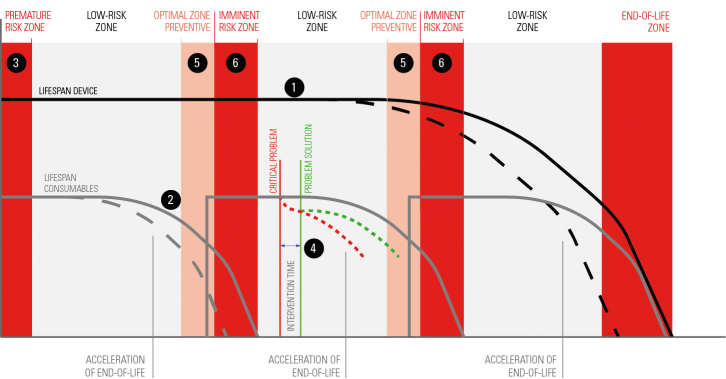
Despite this ideal situation, there is a grey area at the beginning of the device's life (3), in which what’s known as premature death can occur. This can be caused either by a statistical failure in the equipment or by improper dimensioning of the requirements, neither of which is likely to be detected during commissioning. The best way to keep this factor under control is by remotely and constantly monitoring your equipment. Today's new technologies allow us to keep our devices connected and receive real-time notifications and alarms. SALICRU's technical service offers, among other things, remote monitoring, monthly equipment status reporting and a response time of less than 24 hours.
Comparatively, having equipment connected to our remote maintenance service would be the equivalent of having a medical centre monitoring your neurological system in real time and being able to act swiftly at the slightest sign of illness. This extended connectivity also allows us, at any time, to shorten the intervention time in the event of an unexpected problem (4) or even to propose preventive maintenance (5) and schedule it at the customer's convenience to avoid reaching situations of imminent risk (6), seeking to time the maintenance intervention to ensure minimum impact on the customer's productivity.

All power electronics contain components with a limited service life, which is why they must be regularly monitored and checked to maximise their operating life and minimise inconveniences caused by wear and tear. By doing this, we can ensure that the equipment will continue to operate normally and not be affected by internal failures.
The service lives detailed in this document are derived from statistical averages and are by no means absolute and immovable values because, beyond their physical composition, they can be affected by many other factors external to the device. Among other things, the service regime, environmental pollution, and the working temperature to which they are subjected can all have a direct and significant effect on the overall performance.
Let's take a closer look at an explanation for the various consumables.
DC capacitors (electrolytic)
Our experience has shown that, due to the way in which they are manufactured, these components must be replaced before they reach the end of their service life (estimated at around 5 years) or at the first sign of any deterioration in performance (except for those used in modular systems). The main cause of wear is usually the deterioration of the oxide layer on the internal boards due to the voltage fluctuations to which they are subjected (causing the layer to wear thin) or the appearance and subsequent expansion of a leakage point on the same board, which results in a reduction in the stipulated impedance.
AC capacitors
Although of different construction, the purpose of these types of capacitor is the same, as is the cause of the faults that can occur. In this case, fault detection can be visually corroborated (in addition to the relevant maintenance checks) when a deformity in the capacitor housing is detected due to a difference in internal and external fluid pressures. Replacement after approximately 5 years of service is also recommended.
DC and AC capacitors in modular UPS devices
Due to the architecture of these systems, the capacitors used in modular UPS devices are manufactured to provide an extended service life, with operating hours twice as long as those used in monoblock systems. When nearing the estimated life expectancy, you should check the condition of the DC and AC capacitors to decide whether they should be replaced or whether their maintenance period can be extended due to the working conditions in which they have been operating.
Fans
Their cooling function makes these elements important for preventing other problems caused by overtemperature. Consequently, any incorrect functioning will compromise other components. As they are essentially mechanical components in constant motion, the accumulation of dirt due to the suction effect, or wear and tear to the small internal motor are the main causes of faults. They should be replaced every 5 years of service.
Batteries
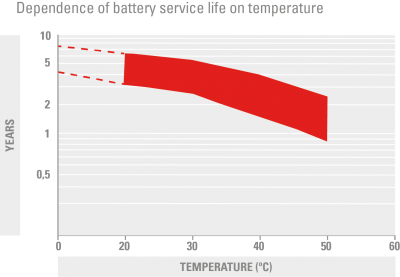
Batteries are the UPS components that require the most attention due to their function and sometimes because of the high number of components per unit (the more components, the higher the statistical probability of failure). They are also probably the components most susceptible to being affected by external factors. As an example, the graph shows how high temperatures can affect the lifespan of a battery.
The operating time or useful life of Lead-acid batteries (the type most frequently used) is normally judged by battery manufacturers to be the point at which they can no longer support a proper charge or when the available capacity of the battery is equal to or less than 70% of the original capacity. In general terms, the useful life of every battery is marked in the manufacturer's specifications and at Salicru, we have two types: batteries with a useful life of 5 years, which must be replaced after 3-4 years, and batteries with a useful life of 10 years, which must be replaced after 3-4 years and 6-8 years respectively.
If the battery pack is not performing its intended function you can check its level of deterioration by carrying out routine maintenance checks. More visible signs are when the sulphation of the electrolyte reaches the outside of the housing or a strong acidic odour is given off, but these are extreme fault situations that should never be allowed to occur.


 MONTAWEB.com