






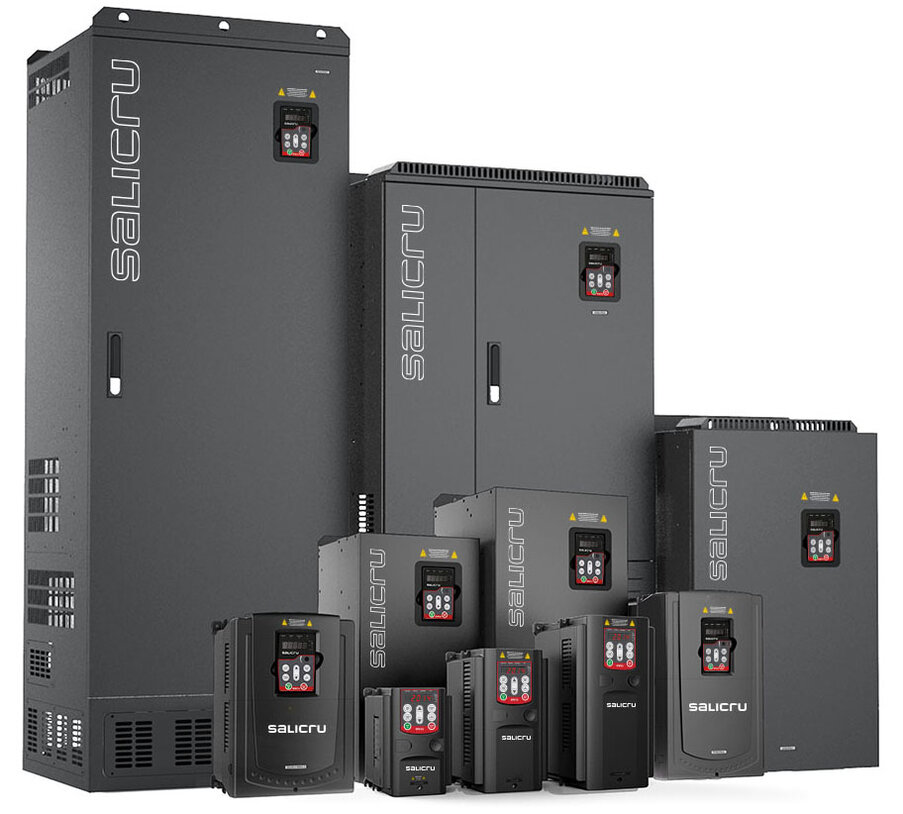
Variable Frequency Drives (VFD) are devices that can control induction motors through changes in the frequency of the output voltage. They can be configured depending on their use: fans, industrial extractors and cooker hoods, conveyor belts, pumps, mixers, saws, oscillators, blowers, industrial dryers, advertising displays, etc.
They receive their power supply from the installation’s AC mains and convert it into DC via a bridge rectifier. The VFD smooths the direct current by passing it through a filter to obtain a cleaner signal and then converts it back into an alternating current with the frequency and amplitude controlled by the drive. The device uses semiconductors that switch rapidly between conduction and cutoff states to produce a controlled output waveform.
In the final stage, the VFD adjusts the frequency of the output signal to control the speed of the motor. The higher the frequency, the higher the speed of the motor. A VFD may also have control circuits that adjust the output frequency according to the speed demanded by the motor. This can be done by providing feedback on the motor speed via sensors or programming predefined parameters.
Variable frequency drives reduce mechanical wear and tear and extend the service life of the equipment by ensuring the motor starts up and shuts down smoothly. They allow control over speed, direction and torque to be more precise, thus improving processes and allowing them to be automated and integrated with complex management systems or industrial processes.
In an induction motor, magnetic flux and torque are intrinsically linked through the electric current flowing in the stator. With traditional control, adjusting one of these elements affects the other, which may be undesirable in some usage settings. Vector control overcomes this limitation with control algorithms to decouple the magnetic flux from the motor torque. This is achieved by transforming the stator phase currents into two orthogonal components: one controlling the magnetic flux and the other controlling the torque.


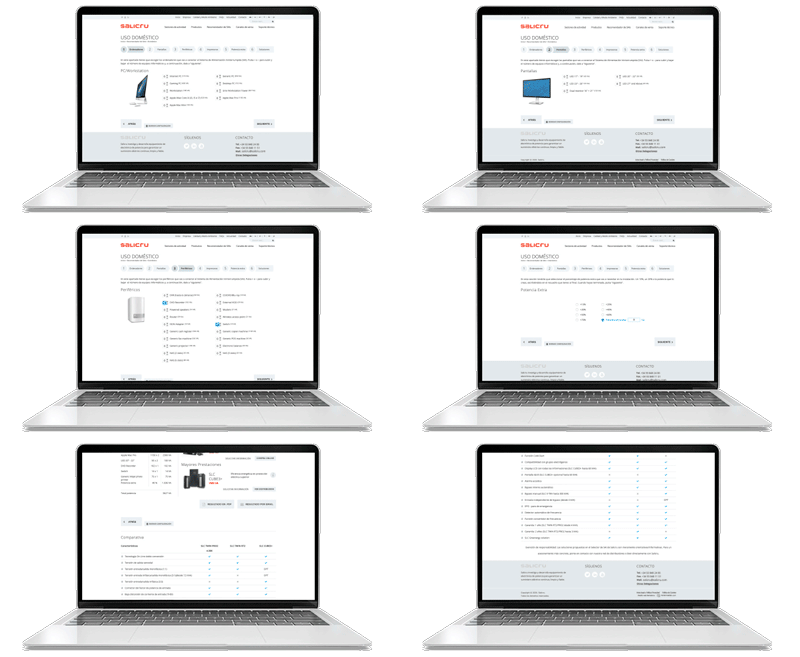
Which VFD to choose depends essentially on the type and power of the motor to which it will be connected.
Electric motors have two main parts: the stator and the rotor. The stator is static and surrounds the rotor, and its function is to receive electricity and create a rolling electromagnetic field, which the rotor follows. Depending on how this field pushes the rotor, there are two types of motors.
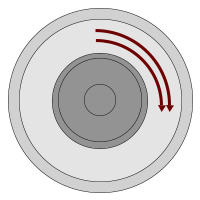
The electromagnetic field and the rotor rotate synchronously, at a constant speed, in synchrony with the frequency of the supply current. They work efficiently with constant loads and are used in applications that require a constant speed under different load conditions.
.png)
The electromagnetic field is faster than the rotor, which means that the speed varies with the load and is not proportional to the power frequency. They are more robust and less expensive than synchronous motors and are widely used in industry due to their simplicity and durability. Using a variable frequency drive significantly improves their speed control and efficiency.
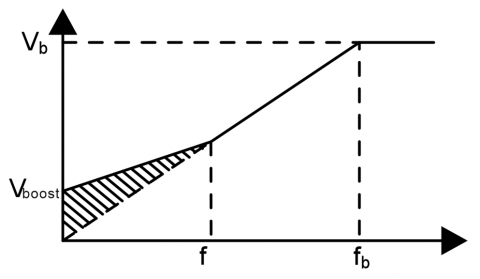
In voltage-frequency control mode, the output voltage is always proportional to the frequency, as this keeps the magnetic flux in the motor constant and allows the motor torque to be maintained at any selected speed. The exception to this is during startup, when the VFD supplies more output voltage to overcome friction. This function is known as Boost.
.jpg)
Vector control involves independently manipulating the magnitude and phase of the currents feeding the motor, allowing speed and torque to be controlled separately. This is achieved by estimating and controlling the current and magnetic flux in the motor.
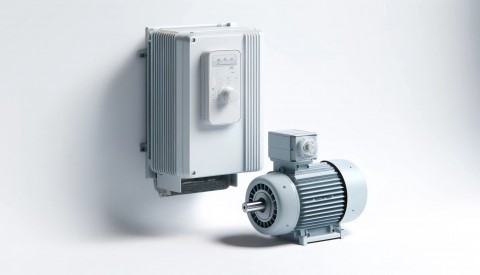
VFDs often come with flange mount adapters as accessories, which provide protection in dusty environments by keeping the electronics in a clean space while the radiator is exposed to the environment to dissipate heat. Additional consoles allow remote control and copying of the drive parameters.
To protect against interference and disturbances, given that the characteristics of one power line may differ from the next, VFDs may also require a few add-ons. Output ferrite beads reduce voltage spikes and premature motor ageing and are recommended for installations with cables between 50 and 100 metres. Sine filters convert the waveform into pure sinusoids, eliminating problems caused by IGBT switching, and line inductors reduce harmonics and protect against overvoltages and micro-outages.
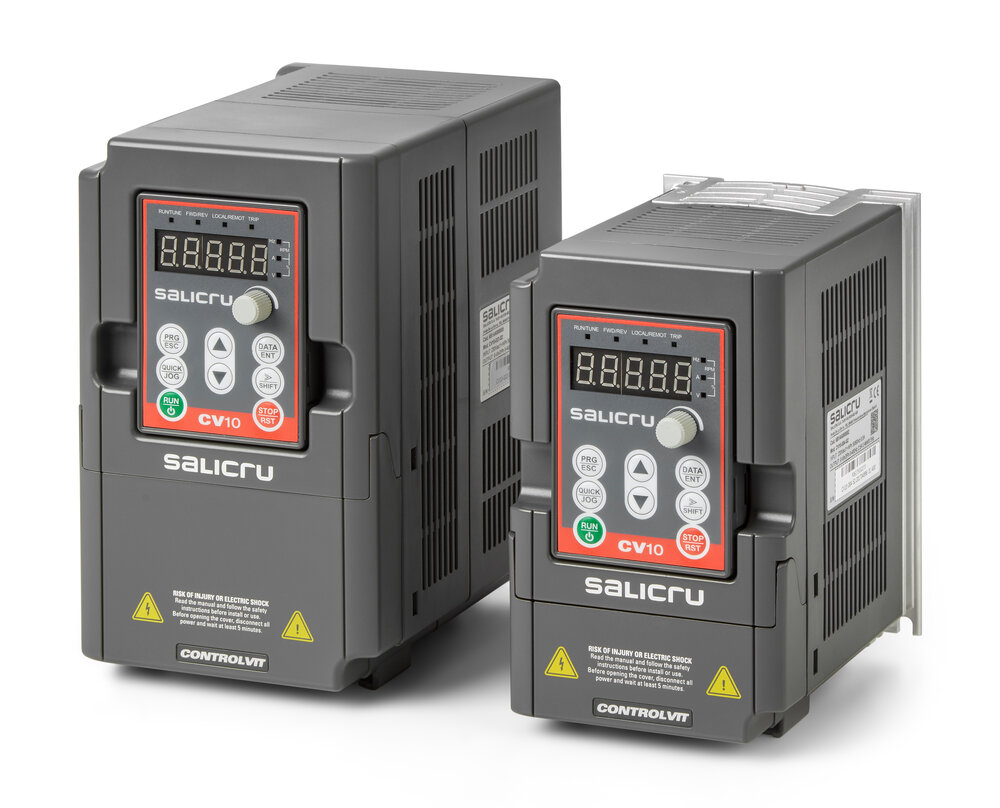
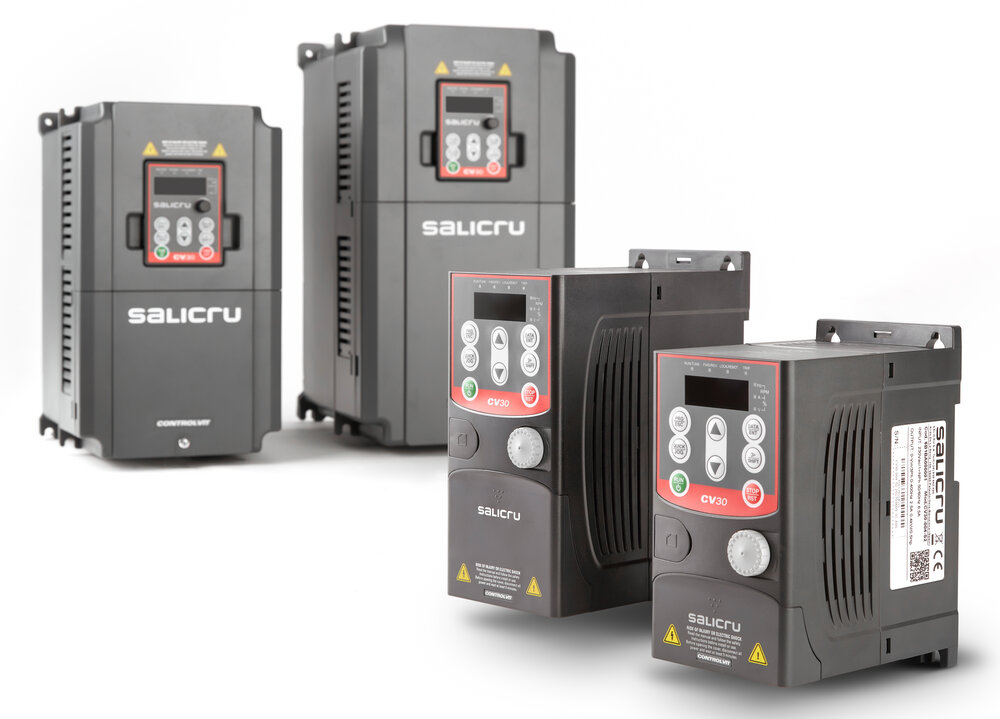

This enables the drives to be connected to a computer, configured and monitored to facilitate commissioning and maintenance.
- Import and export of drive parameter setting files.
- Display and modification of parameters.
- Quick comparison between programmed and default parameters.
- Oscilloscope with up to 10 channels, with data storage, export, etc.
- Multiple monitoring: one PC can monitor different drives at the same time.

Saving energy by implementing solutions that optimise efficiency is one of today's most relevant issues and will undoubtedly remain so in the future. Geopolitical factors aside, there has been a shift in public awareness of the need to reduce carbon emissions: a goal that demands we reduce our energy consumption.
.jpg)
The whole world is dealing with the consequences of climate change, which affects us all. But there can be no doubt, at least from a purely economic point of view, that the agricultural sector will be one of the first industries to have to take on this enormous challenge.

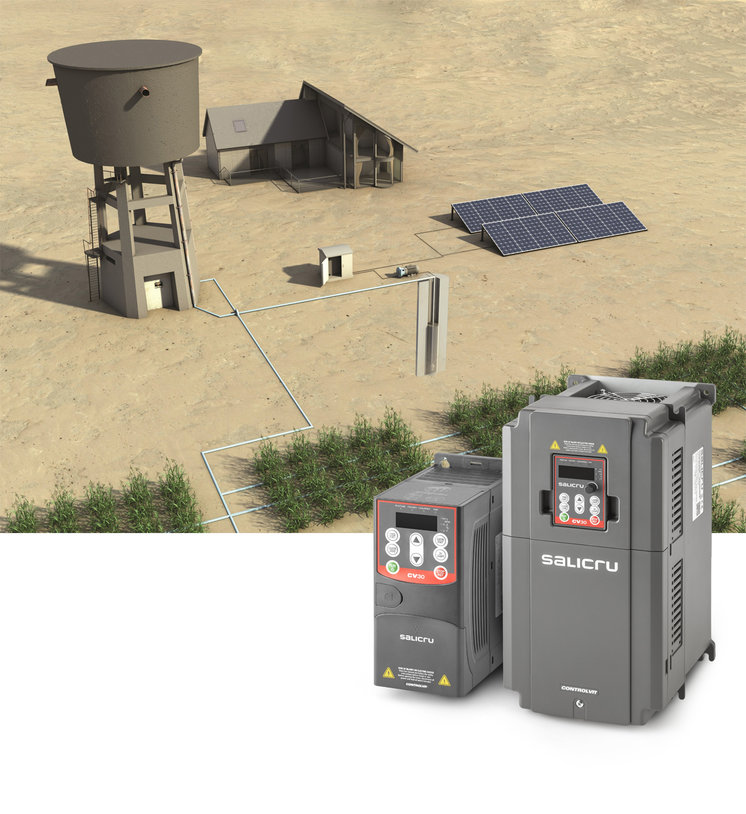
Salicru solar pumping solutions have played a key role in this natural park, whose rice fields extend over both hemispheres of the delta and whose hydrographic distribution is conditioned by two extensive irrigation networks that carry water to the fields and return it to the sea.


 MONTAWEB.com