






News
ADIF, the Spanish state rail operator, is looking to monetise its high-power electrified rail infrastructure – whose energy potential is currently under-used – by recovering braking energy from trains and installing charging points for electric vehicles (EVs) at 1,500 stations across the rail network. Salicru is developing a prototype system that will enter the testing phase in early 2024.
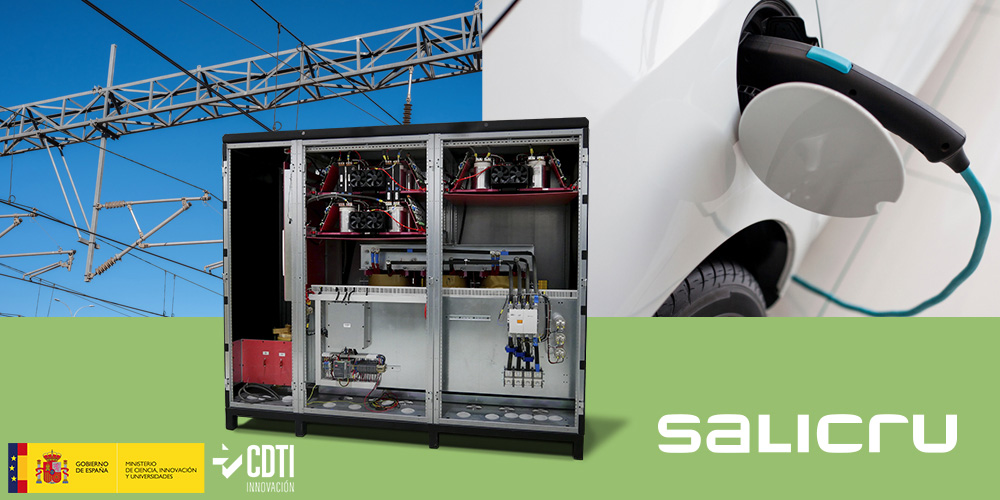
The conversion of the high catenary voltages into three-phase low voltage to supply EV chargers must ensure the provision of high power (up to 500 kW) and galvanic isolation of six times the working voltage (18.5 kV), as well as providing high levels of performance, in view of the fact that the energy is to be sold.
The first prototype will be installed at Madrid-Atocha station, which is already equipped with Salicru DC POWER-L digitally controlled thyristor rectifiers. It is an innovative solution that is based on a 250 kW five-level (nine phase-to-phase levels) converter that can be run in parallel and boasts high levels of performance (around 96% at a switching frequency of 7 kHz, thereby reducing acoustic noise). These characteristics are seldom found in converters with these levels of voltage and power.
Moreover, Salicru is going a step further and developing a solution to supply energy to isolated parts of the rail infrastructure, and has also developed a 125 kW model that provides similar performance but with a switching frequency of 10 kHz, producing very little acoustic noise. The two parallelable modular designs also enable connection to the grid and bidirectional operation, as well as reactive power management and harmonic compensation.
For high-speed lines such as the AVE, whose high voltage is 25 kV AC, Salicru provides low-voltage, single phase to three-phase converters that perform the same function.
The Ferrolinera project is subsidized by the Center for Technological Development and Innovation (CDTI) of the Government of Spain.






 MONTAWEB.com