






News
Total cost of ownership, generally referred to as TCO, enables us to estimate the total cost of a product throughout its useful life cycle. As such, it takes into account the sum of all of the costs related to the product’s acquisition, use, management and disposal. TCO is a highly relevant concept in technology, and uninterruptible power supplies (UPS) are no exception.
Therefore, when choosing a UPS, it is worth considering which option best allows us to minimise TCO. Modular UPS systems are an ideal option because they reduce operating expenses (OPEX) and, with proper management, provide maximum energy efficiency. They also reduce capital expenditure (CAPEX), as the production of a large volume of identical modules enables the manufacturer to take advantage of economies of scale, which, in turn, lowers the manufacturing costs of the UPS. It is therefore a winning strategy for both the manufacturer and the customer.
Increased performance and efficiency
In addition to the financial benefits they provide, modular UPS systems have also seen continuous performance improvements in recent years. The architecture of the converters has evolved from 6 and 12-pulse rectifiers to initial thyristors and, latterly, to active PWM rectifiers, while ferro-resonant or PWM inverters with low-frequency transformers have been replaced by the current transformerless, multi-level three-phase inverters.
These technological advances have led to tremendous improvements in efficiency, from an initial 88% to around 96-97% today. The improved performance provided by multi-level switching technologies makes it possible to significantly increase the system’s availability by adopting an N+1 parallel UPS configuration, where N is the number of UPS units required and 1 is the UPS used as a redundant back-up.
This setup achieves between 99.999% availability, equivalent to 5 minutes of non-availability in a year, and 99.9999%, equal to 30 seconds of non-availability in a year. These levels safeguard supply in critical operations such as data centres.
Salicru’s solutions: SLC ADAPT and SLC ADAPT2
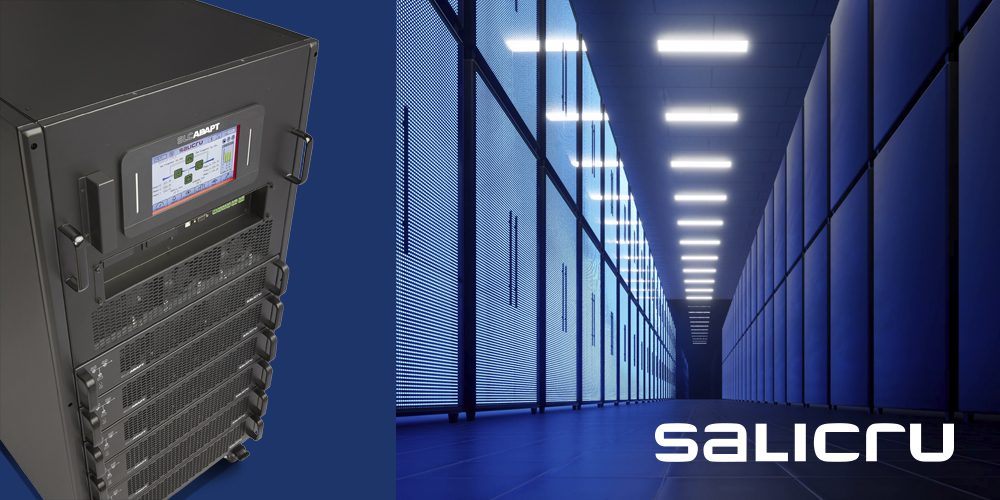
Salicru’s product range includes two modular UPS systems that optimise TCO: the SLC ADAPT and SLC ADAPT2 series.
The modular UPS systems in the SLC ADAPT series are based on on-line double conversion technology with DSP control and three-level IGBT inverter, and can be configured to provide solutions ranging from 25 kVA up to 1500 kVA using 25, 30 and 50 kVA modules. They can be connected to form systems consisting of 6, 8, 10 or 12 modules, and when combined with the parallel/redundant option they can provide up to three 500 kVA systems.
For its part, the SLC ADAPT2 series is based on the same technology and uses 10 and 15 kW modules. The systems can be configured with 2, 3, 4 or 6 modules to offer parallel growth up to a power rating of 450 kW. The SLC ADAPT2 UPS devices also include, as standard, a Nimbus IoT cloud connection to enable monitoring.
Both series offer improved TCO thanks to their tremendous versatility and their ability to adapt to all environments and needs. The client only needs to pay more if more power is required (“pay as you grow”). TCO is further optimised by the high power density of these UPS devices; in other words, they take up less space and, consequently, cost less to install.
Furthermore, the modules can be added or replaced during operation (hot-swap). In short, the investment is optimised because it can be tailored to suit the rate of growth required by the data centre: all the client has to do is install new modules, which is an inexpensive and straightforward process.






 MONTAWEB.com